
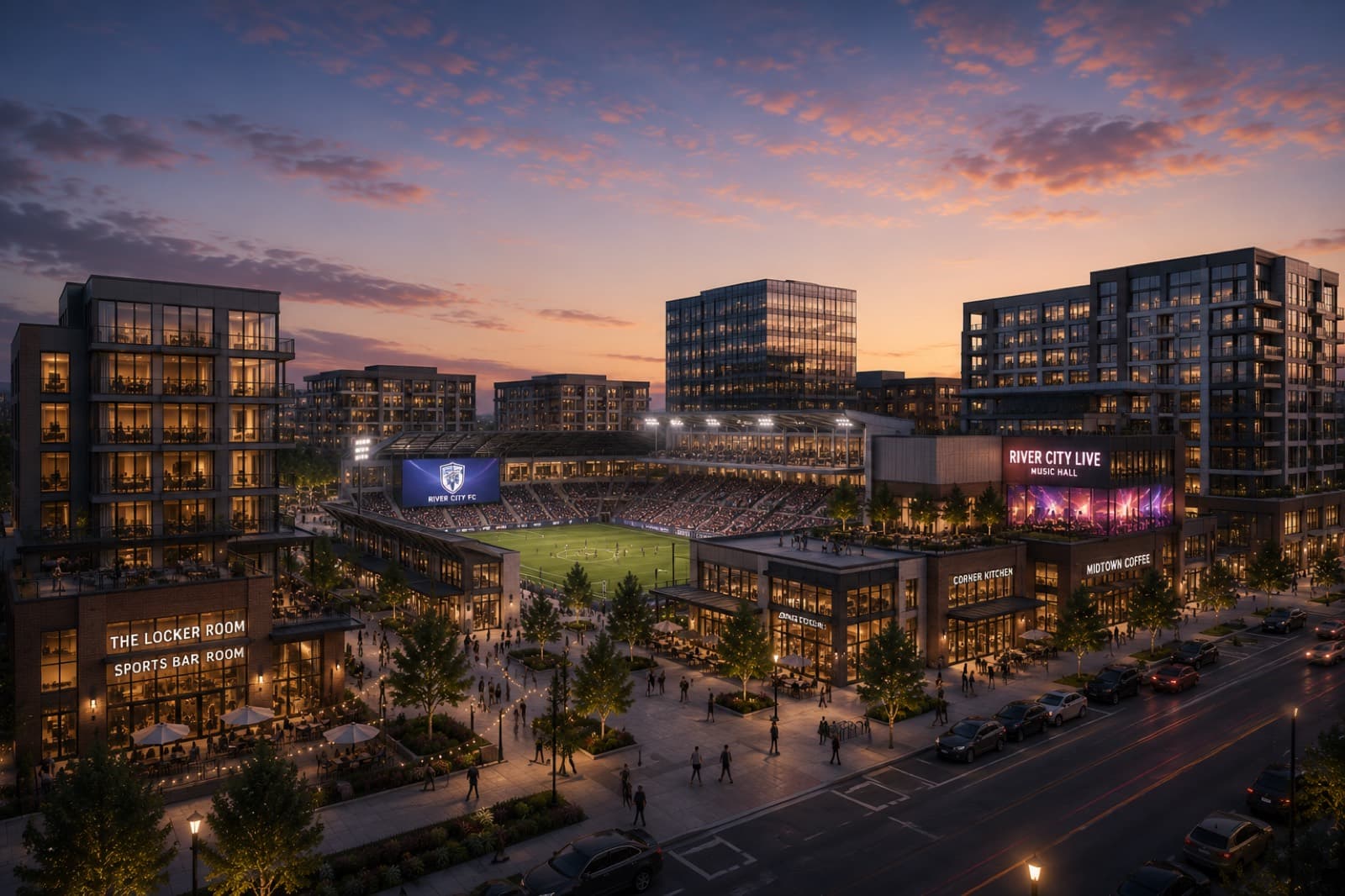
$800M Mixed-Use Sports & Entertainment District.
$800M Mixed-Use Sports & Entertainment District
Underwriting architecture for an $800M ground-up sports and entertainment district — coordinating phased vertical delivery across residential, retail, hospitality, and venue components under a single capital plan.
01The opportunity
A real estate developer engaged InstitutionalModels™ to build the financial underwriting for a master-planned sports and entertainment district — a multi-asset, mixed-use development spanning residential, hospitality, a professional soccer venue, and for-sale horizontal residential.
The models had to serve three audiences at once: the city, to demonstrate feasibility and support a Tax Increment Financing (TIF) designation; lenders and investors, to obtain letters of intent; and the development team itself, navigating a project where nearly every major assumption — capital stack, city grant, stadium sizing, phasing — was still in flux.
02The challenge
Four distinct asset classes needed to follow a parallel structure — each standing alone for asset-level underwriting, rolling up cleanly into district-wide returns, and legible to lenders and investors without any translation layer. A professional soccer venue, in particular, has no stabilized lease NOI: its revenue is event-driven, multi-stream, and dependent on team performance and scheduling, which a standard income-property model cannot represent.
The challenge was structural: build four fundamentally different underwriting approaches that nonetheless share one architecture, one audit logic, and one consolidated view.
03The approach
InstitutionalModels™ built a suite of four parallel models, each tailored to its asset class. Mixed-use residential and retail used a multi-phase structure with BMR set-asides and structured parking. Hospitality was built on RevPAR-based revenue with departmentalized operating margins. The townhomes used a profit-margin and project-level return framework rather than a stabilized NOI model.
The soccer stadium required a purpose-specific revenue engine: a seven-stream, event-based model with team viability assessment and a dynamic stadium-sizing toggle spanning baseline and expanded configurations.
Every model shares a single-screen dashboard, a grey-formatted driver layer for full auditability, and a formula-driven waterfall with no macros — so changing any assumption recalculates the entire suite in real time.
Four integrated components in a single financial model.
Phased delivery modeling
Each vertical component is underwritten on its own delivery schedule with construction, lease-up, and stabilization windows — timed independently while flowing into a single project-level cash flow.
Component-level capitalization
Debt, equity, and public financing sources are allocated at the component level with independent draw and repayment logic, preserving lender-by-lender diligence within a consolidated capital plan.
Venue and public revenue integration
Non-traditional revenue streams — venue operations, parking, public participation — are underwritten alongside real estate income with clear attribution to the sponsors that own each stream.
Executive reporting layer
The output layer produces investor and municipal reporting formats directly from the underwriting model, without secondary decks or export steps.
Publication pending.
The full-length case study is being prepared. Enter your details and we’ll notify you when it—along with future case studies—becomes available.