
ARGUS underwriting for a $400M institutional mandate.
An institutional investor moving into the open-air retail wave — turning broker ARGUS exports into acquisition-ready underwriting in minutes, without diverting internal resources or slowing deal velocity.
Representative case study. Client and figures anonymized; illustrative only — not investment advice or an offer.
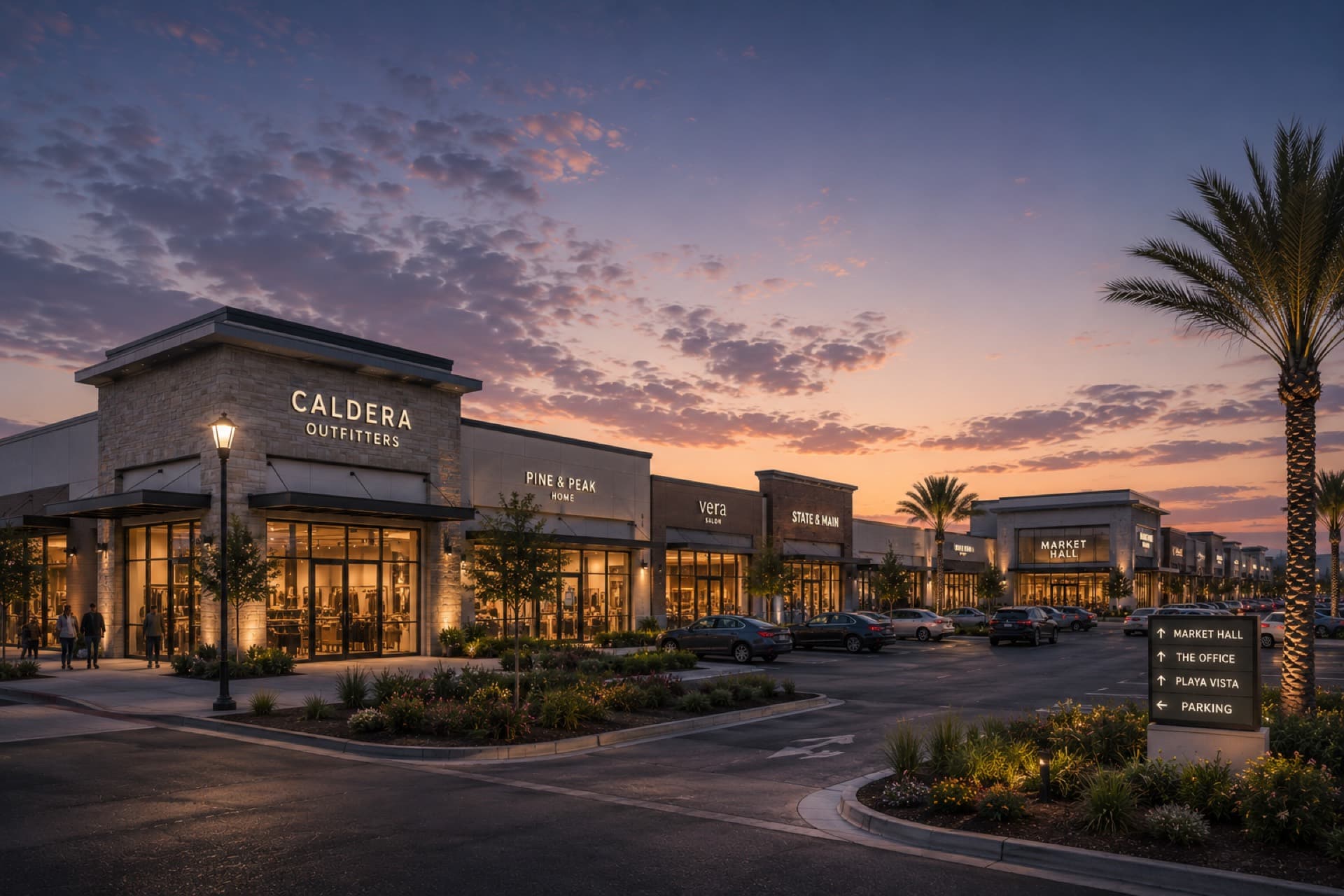
The wave that came back to open-air retail.
For a decade institutional capital retreated from retail. The return has been decisive — necessity- and grocery-anchored open-air centers now command the highest share of institutional real estate investment in a decade, backed by a supply pipeline that has run at roughly half a percent of inventory a year since 2009.
The named commitments below define the market our client was underwriting into — the reason speed at the ARGUS-to-Excel handoff was not an efficiency gain, but a competitive one.
- NovBridge33 CapitalReal Estate Partners III · final close
- Q1Kimco RealtyRPT Realty merger · 56 open-air centers
- JunSterling OrganizationValue Add Partners IV · hard-cap close
- OctSITE CentersCurbline Properties spin-off · 79 centers
- NovBlackstone Real EstateROIC take-private · 93 grocery-anchored
- MayNuveen Real EstateUS Cities Retail Fund · institutional close
- JunAres · Koch RERCG Ventures multi-tenant portfolio
- DecBain Capital · 11North PartnersOpen-air retail platform raise
- MarREST (Australia) → NuveenUS Cities Retail anchor commitment
- AprCBRE IM · MCB Real EstateGrocery-anchored portfolio JV
- AprAres ManagementWhitestone REIT acquisition (announced)
“Strong conviction in necessity-based, grocery-anchored shopping centers in densely populated geographies… benefiting from nearly a decade of virtually no new construction.”
“Open-air strip retail is experiencing increasing tailwinds for the first time in over a decade as the supply-demand dynamic is shifting in favor of landlords.”
Broker files versus deal velocity
The firm was moving into that market — a leading institutional investor, backed by a senior money manager, acquiring open-air retail centers between $20 million and $150 million where parcel structure, recoveries, and tenant-level economics demand careful underwriting. Speed was central to the firm’s edge. Top-tier centers were drawing eight or more competitive bids and best-and-final windows had compressed to a matter of days.
The friction was not the market. It was the handoff. Broker ARGUS files vary widely in structure and assumptions, and the industry convention is well documented: five to ten percent of NOI is optimism baked into the export, which translates into 25 to 50 basis points of cap-rate movement at a fixed price. Institutional teams routinely spend 60 to 70 percent of their underwriting time on manual data extraction, and a single middle-market deal runs 25 or more analyst hours before it reaches committee.
Analysts rebuilt rent rolls, reconciled recoveries, and re-derived timing before a deal could be evaluated on the firm’s own terms. Asking analysts to work faster would not solve it. Building a specialized platform internally would have pulled focus from acquisitions during an active market. The firm needed a system that absorbed ARGUS at scale, on a tight timeline, without diverting resources.
Excel as the underwriting engine. ARGUS as the data source.
Nothing else could do what the firm needed. Institutional acquisitions run on Excel because investment committees read formulas — every assumption traceable to a cell, every waterfall and promote and refinance flexible enough to model a bespoke capital structure. Off-the-shelf platforms hard-wire schemas that break on the first non-standard JV; ARGUS itself is powerful for asset management but reads to reviewers as a black box. The client’s IC needed the model open.
The system InstitutionalModels™ built runs the entire acquisition workflow from two ARGUS exports — the Cash Flow report and the Rent Roll report. Both drop into a normalization layer that absorbs the variation in how brokers structure their files. Downstream, a single Assumptions tab recalculates the operating statement, debt schedule, and return metrics on every input change. The analyst never opens ARGUS.
Parcel structure earned its own architecture. Cap rates within a single open-air center span more than three hundred basis points — a corporate-guaranteed ground lease may trade below 5 percent while an unanchored inline strip trades above 7 — and blended assumptions have been shown to mis-value centers by 5 to 15 percent. Each parcel carries its own square footage, allocation, exit month, cap-rate override, and independent financing.
- ARGUS_CF
- ARGUS_RR
- ARGUS_Lists
- OpEx Categories
- DataLists
- RR
- CF
- Assumptions
- Debt
- Sensitivity
Three outputs, one integrated model
Every downstream output — the operating statement, the rent roll, the recovery reconciliation — traces to the source through standard Excel formulas. Below are three of the platform’s printed outputs, drawn from the working model.
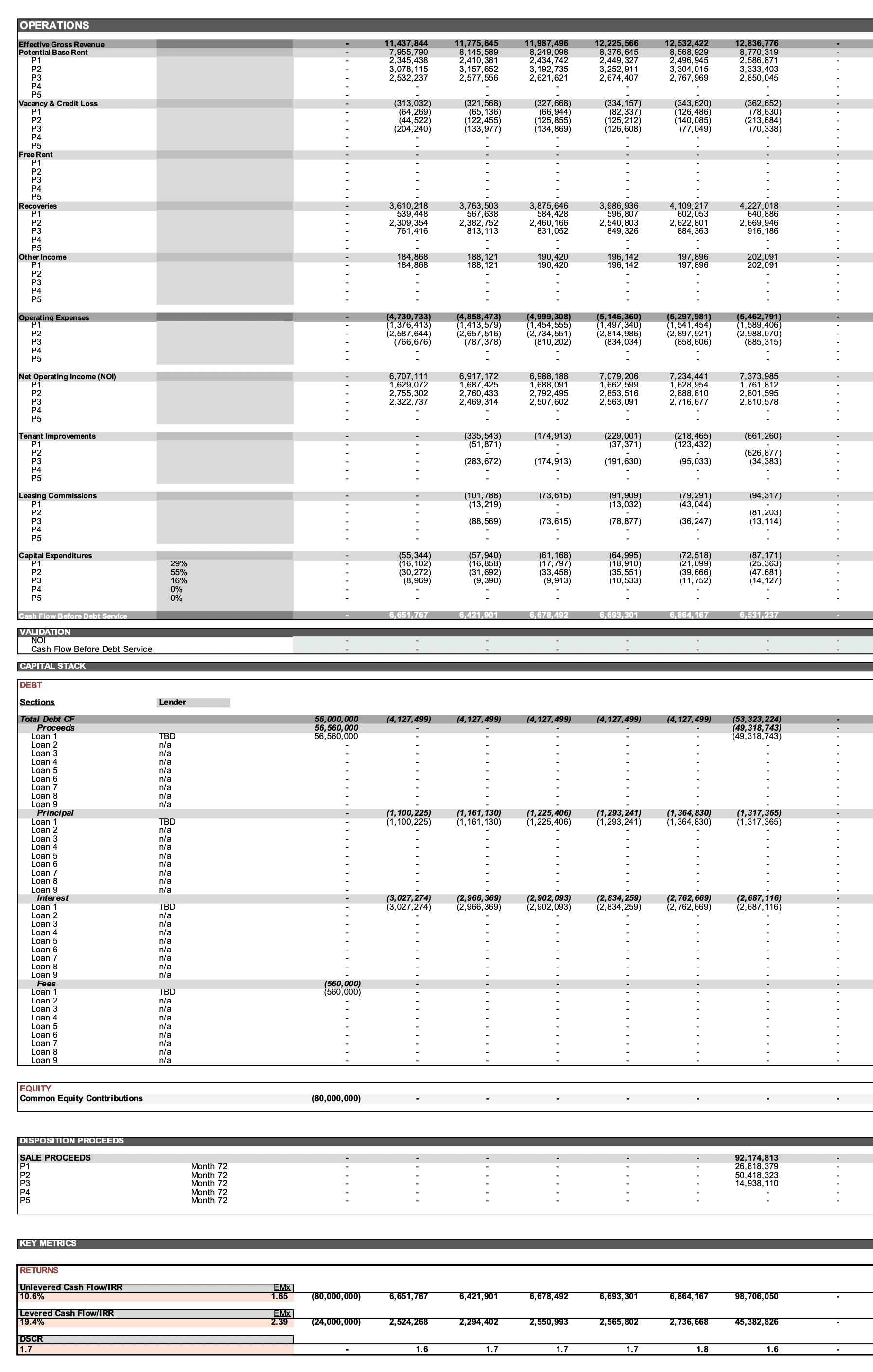
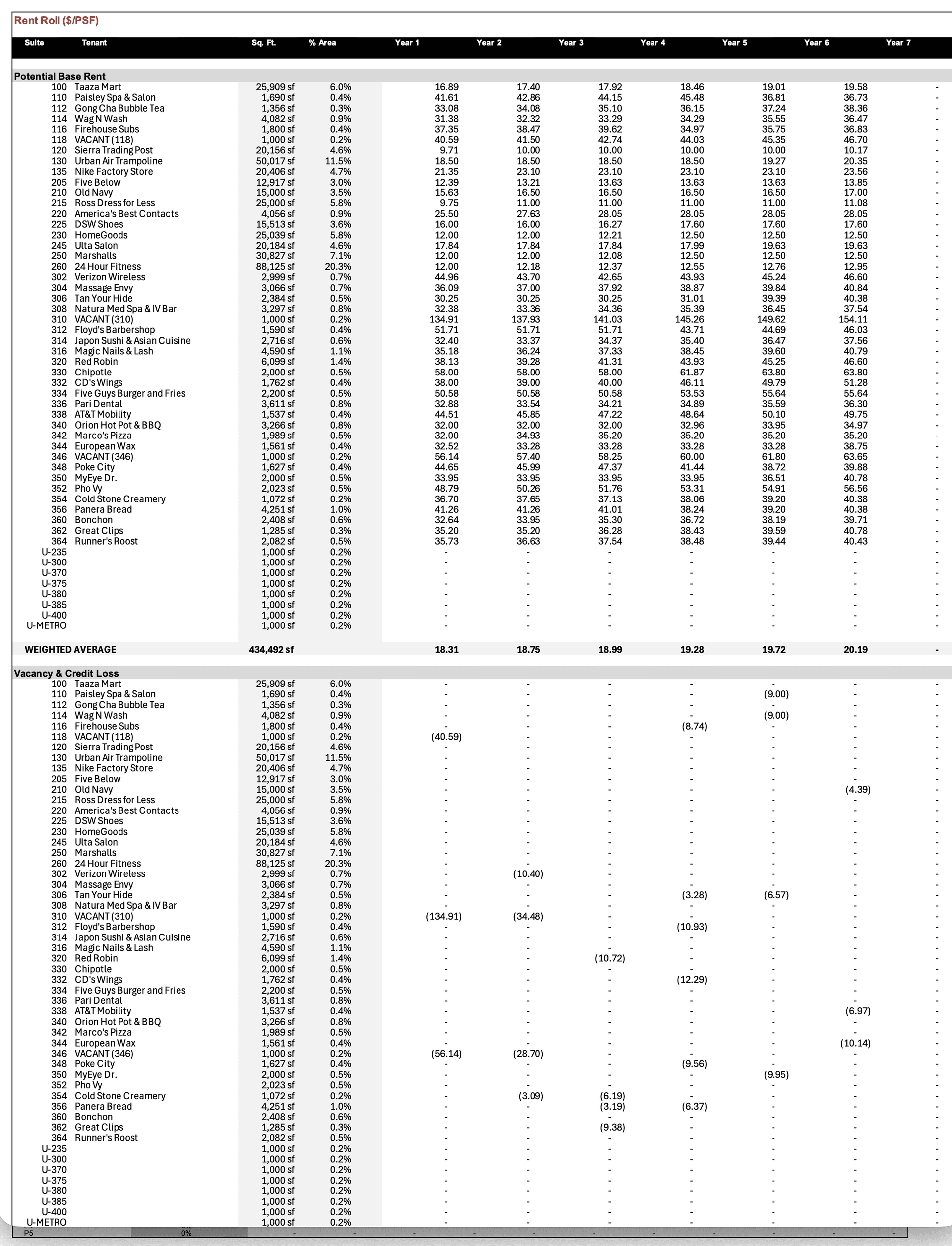

Each parcel with its own economics — from one input tab.
Independent square footage, allocation, exit month, cap-rate override, and financing per parcel — the model recalculates from a single centralized input.
- GLA
- 84,320
- Allocation
- 32.4%
- Exit
- Mo 60
- Cap
- 6.75%
- Facility
- Loan 1
- GLA
- 42,150
- Allocation
- 18.7%
- Exit
- Mo 60
- Cap
- 7.00%
- Facility
- Loan 1
- GLA
- 58,890
- Allocation
- 28.1%
- Exit
- Mo 48
- Cap
- 6.50%
- Facility
- Loan 2
- GLA
- 31,240
- Allocation
- 20.8%
- Exit
- Mo 60
- Cap
- 7.25%
- Facility
- Loan 2
Independent checks reconcile every layer.
A structured reconciliation runs across every layer of the model — no output is trusted without a check tying it to the source it depends on.
A firm that didn’t have to choose.
The result was the realization of the firm’s vision for a fully integrated underwriting system — one capable of translating broker ARGUS exports into acquisition models in minutes rather than hours.
Analysts underwrite opportunities efficiently, while senior management reviews assumptions with confidence. The platform scales with the firm’s capital deployment capacity without disrupting deal flow.
Most importantly, the firm did not have to choose between pursuing opportunities and building infrastructure. It was able to do both at once.
“The platform translates broker ARGUS exports into our underwriting model without manual reconstruction at any step. Lease-level cash flows flow straight through to investment-grade outputs — our team spends less time organizing information and more time evaluating opportunities.”
“Alex listened to our needs, developed a vision for the project, and then produced exactly what we needed. The platform he developed has transformed our underwriting.”
The full case study, coming soon.
The long-form PDF is in preparation — additional model exhibits, extended sheet-level detail, and the underlying capitalization walk not fully expanded on this page. Enter your details and we’ll send it as soon as it’s released.
If you elect, you’ll also receive periodic case studies such as this one in your inbox.
No marketing lists. We do not sell or share contact information. See our privacy policy.