Case Study: Development Platform Built for International Capital
────────────
Case Study:
Development Platform Built for International Capital
───────────
Project Overview:
Between 2021 and 2025, Canadian purpose-built rental transformed from a fragmented, regionally dominated asset class into one actively contested by global institutional capital. Greystar entered Canada in 2022. Oxford Properties assembled a 5,000-unit multifamily portfolio across the GTA and Montréal. CAPREIT deployed nearly $670 million into new purpose-built product in 2024 alone. Boardwalk REIT committed $249 million to three towers in Laval. The capital chasing this asset class brought with it a new standard: institutional-grade underwriting, ESG-quantified operations, and return structures legible to investment committees that had seen every variation of this deal globally.
Evoludev was scaling through exactly this window. Founded in 2018 in Repentigny, Québec, the firm had grown into a vertically integrated platform — site selection, engineering, construction, leasing, and asset management in-house — with over 1,200 units delivered or under construction across greater Montréal and Lanaudière. Its joint venture with Fonds immobilier de solidarité FTQ signaled institutional validation at the regional level. Federal programs like CMHC's ACLP and MLI Select had made purpose-built rental viable at scale — but had also raised the precision required of every underwriting assumption, as financing advantages were increasingly bid into land values. The next phase required infrastructure to match: a model capable of presenting to the same standard as any buyer in that market.
Evoludev came to us with a clear vision for their next phase of growth. As institutional capital entered their markets — and their own pipeline scaled to match — they needed a truly institutional-grade underwriting platform built around how they actually operate: their deal structure, their CMHC financing strategy, their separate land entity, their IRR-driven waterfall, and their sustainability advantage. The model needed to work in both French and English, meet the due diligence standards of international capital sources, and present every dimension of the investment thesis with the same precision as any global operator in the market.
InstitutionalModels™ delivered a fully integrated, bilingual development platform built on our institutional Model Architecture — data, calculations, and outputs in distinct, auditable layers. The result was a model Evoludev could present to any investor in any language, with every dimension of the investment thesis visible, traceable, and defensible.
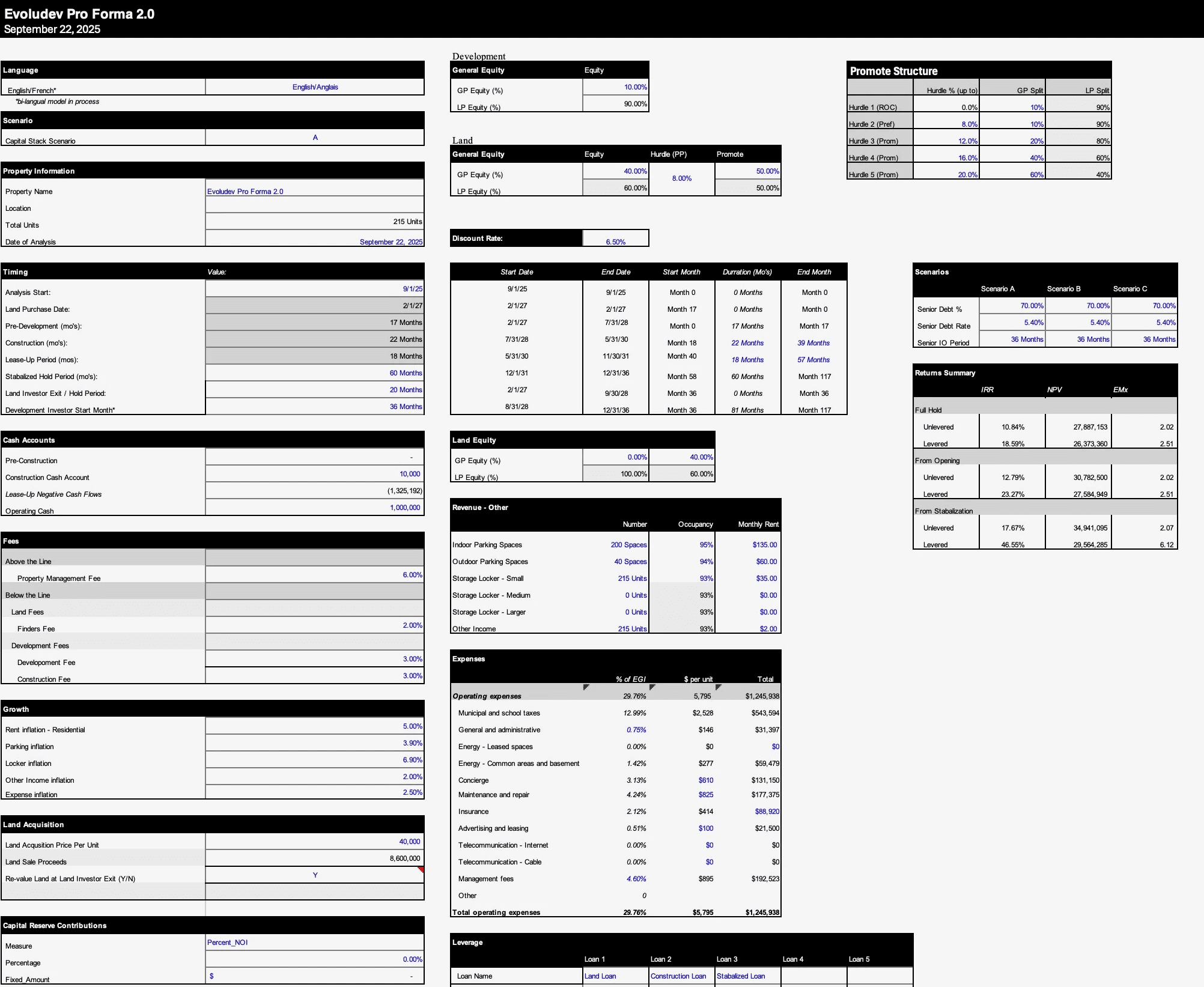
Customized Input Sheet With Language Toggle
Evoludev needed a bilingual model to preserve their French-Canadian roots — their local edge over international developers entering the market — to complete in a global capital environment. The solution was elegant: a built-in dictionary serves as the mapping layer, and a single toggle adjusts every header, label, and output between English and French dynamically, so any capital partner can audit the model in their language with ease.
The language toggle sits at the top of the input sheet, alongside all variables that define the investment — capital stack configuration, promote structure, financing terms, refinancing assumptions, hold period, exit assumptions, fee structures, and growth rates. Every non-development specific input is consolidated in one place, fully dynamic, and updates the entire model in real time.
Customized Input Sheet With Language Toggle
Evoludev needed a bilingual model to preserve their French-Canadian roots — their local edge over international developers entering the market — to complete in a global capital environment. The solution was elegant: a built-in dictionary serves as the mapping layer, and a single toggle adjusts every header, label, and output between English and French dynamically, so any capital partner can audit the model in their language with ease.
The language toggle sits at the top of the input sheet, alongside all variables that define the investment — capital stack configuration, promote structure, financing terms, refinancing assumptions, hold period, exit assumptions, fee structures, and growth rates. Every non-development specific input is consolidated in one place, fully dynamic, and updates the entire model in real time.
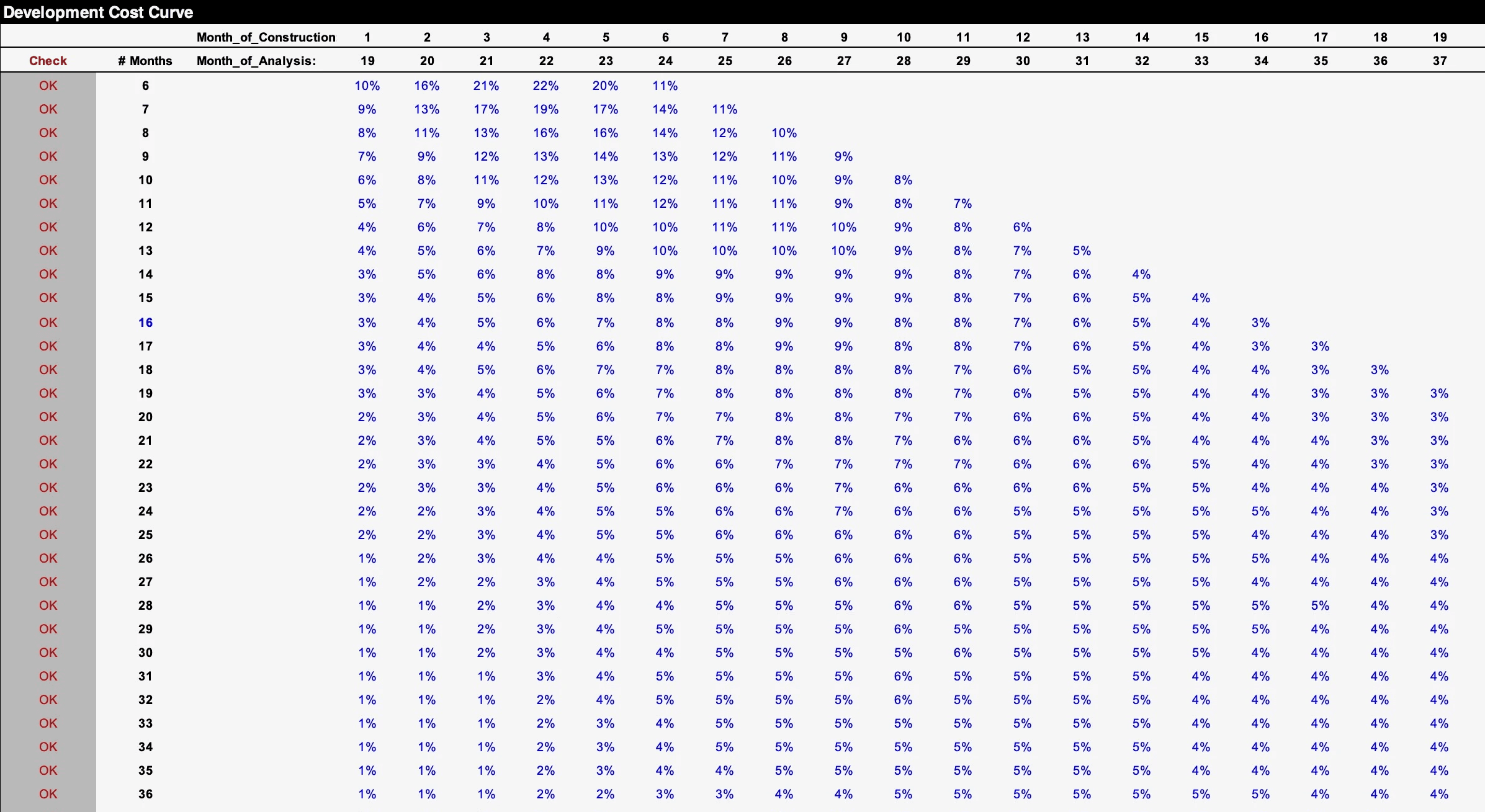
Development Budget, Schedule and Draw Schedule
The Development Inputs tab puts every dimension of construction cost and schedule in one place — organized in the sequence a project actually unfolds, with each phase carrying its own start date, duration, and contingency. Every capital partner sees a complete, auditable cost structure with nothing blended and nothing buried.
The Development Cost Curve, also located on this tab, translates hard costs into a non-linear monthly draw schedule that mirrors how construction capital actually moves — front-light, accelerating through the core build, and tapering at completion — and adjusts dynamically as construction duration changes. This makes the model immediately reusable across projects at different scales and stages.
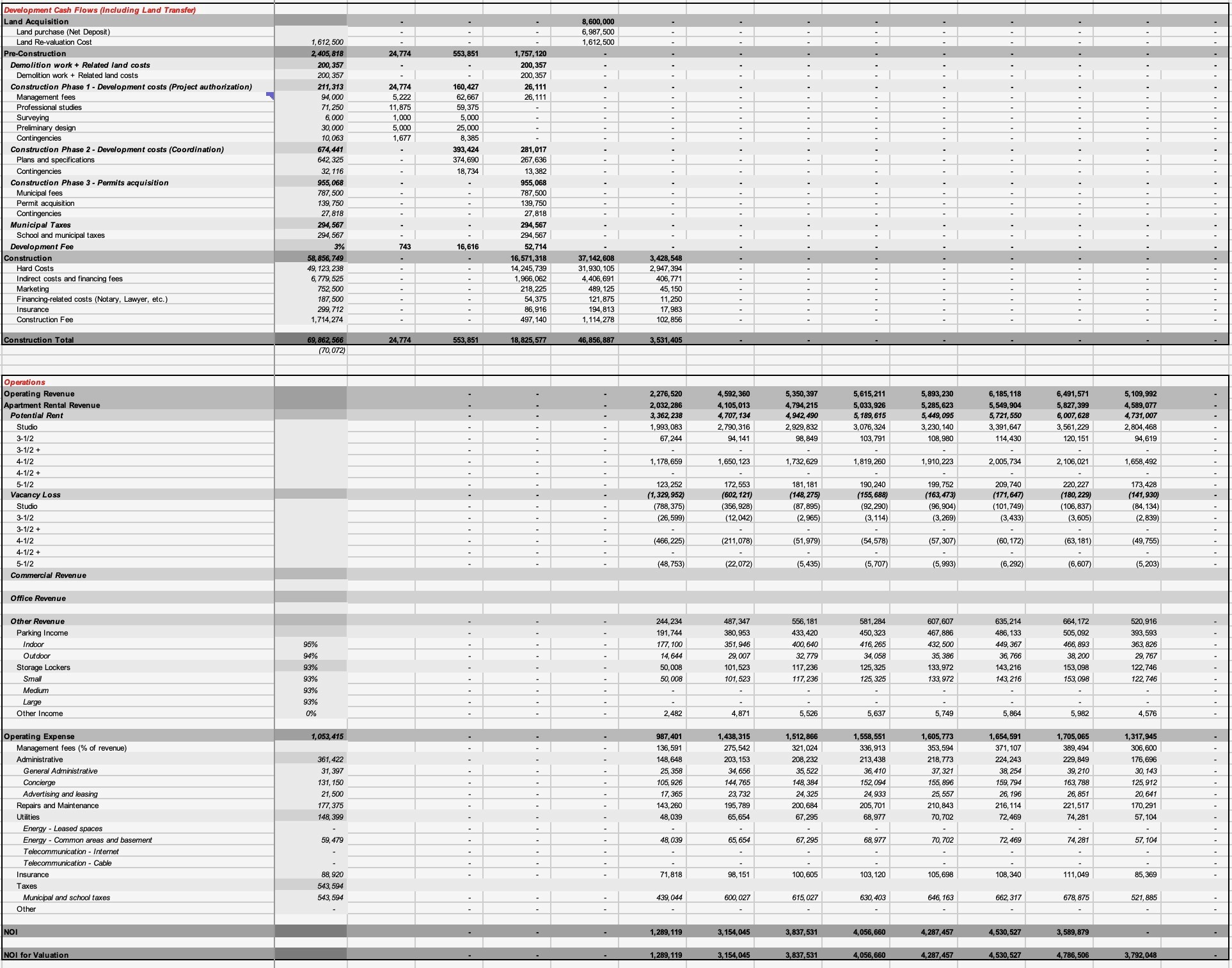
Joint Venture Cash Flow and Calculation Framework
For institutional capital partners, the ability to audit a model quickly is as important as the model's analytical depth. The joint venture cash flow tab is organized around that reality. A band of grey helper rows sits at the top of the sheet — key calculation drivers that consolidate every major assumption in one place, making the sections below them fully transparent.
Construction cost timing is spread across the development period using an S-curve distribution embedded directly in this layer, so the draw schedule flowing into the development section is never a black box. Any reviewer can trace a number from the summary back to the assumption driving it in a single step, compressing the time between first review and investment conviction.
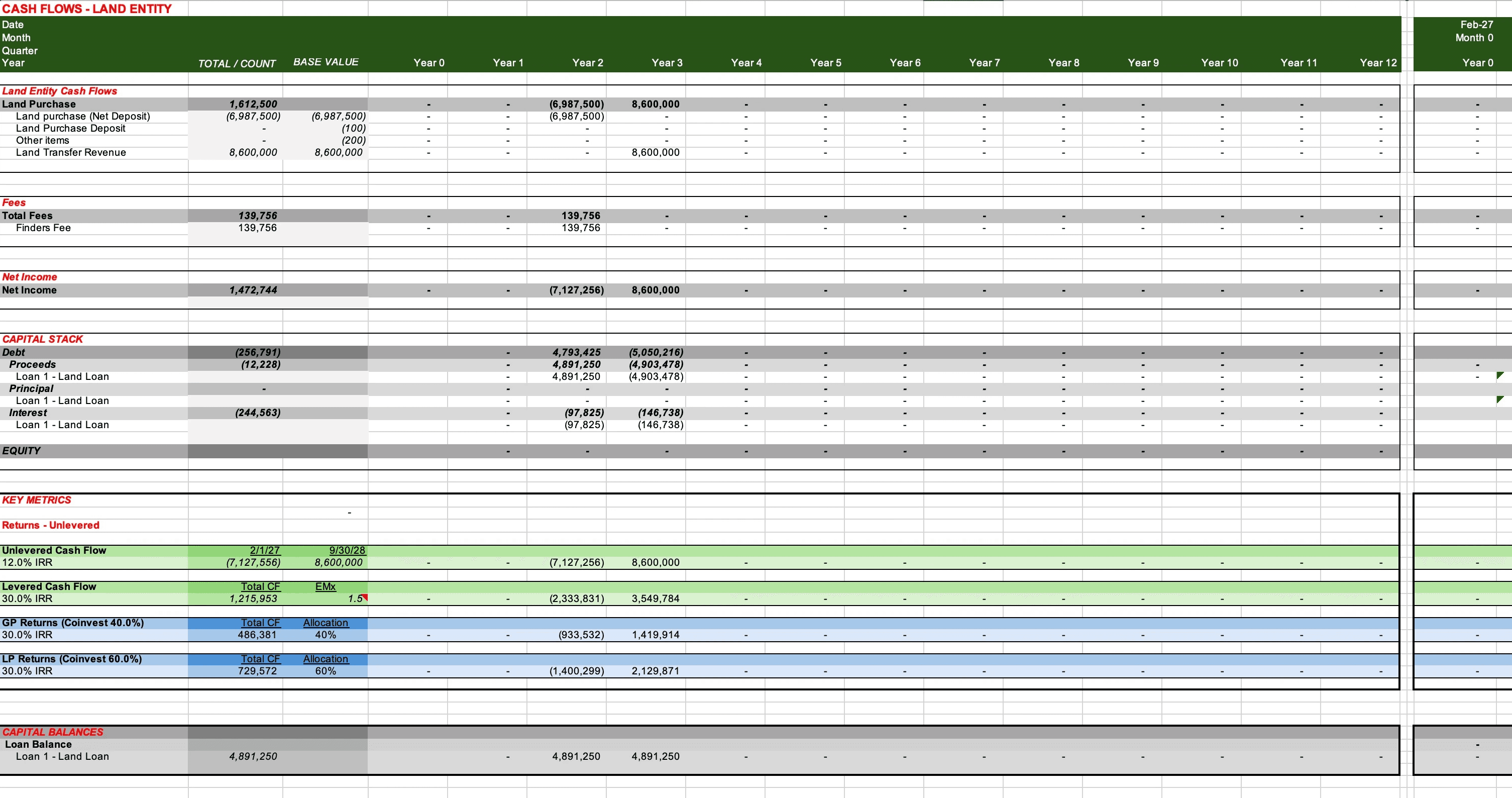
Below the driver band, the tab moves through four sequential sections: Development, Operations, Capital, and Return Calculations. Each section is self-contained but architecturally consistent with the Land Entity tab — same structure, same labeling conventions — so navigating between entities requires no reorientation.
Returns Attribution and Capital Balances
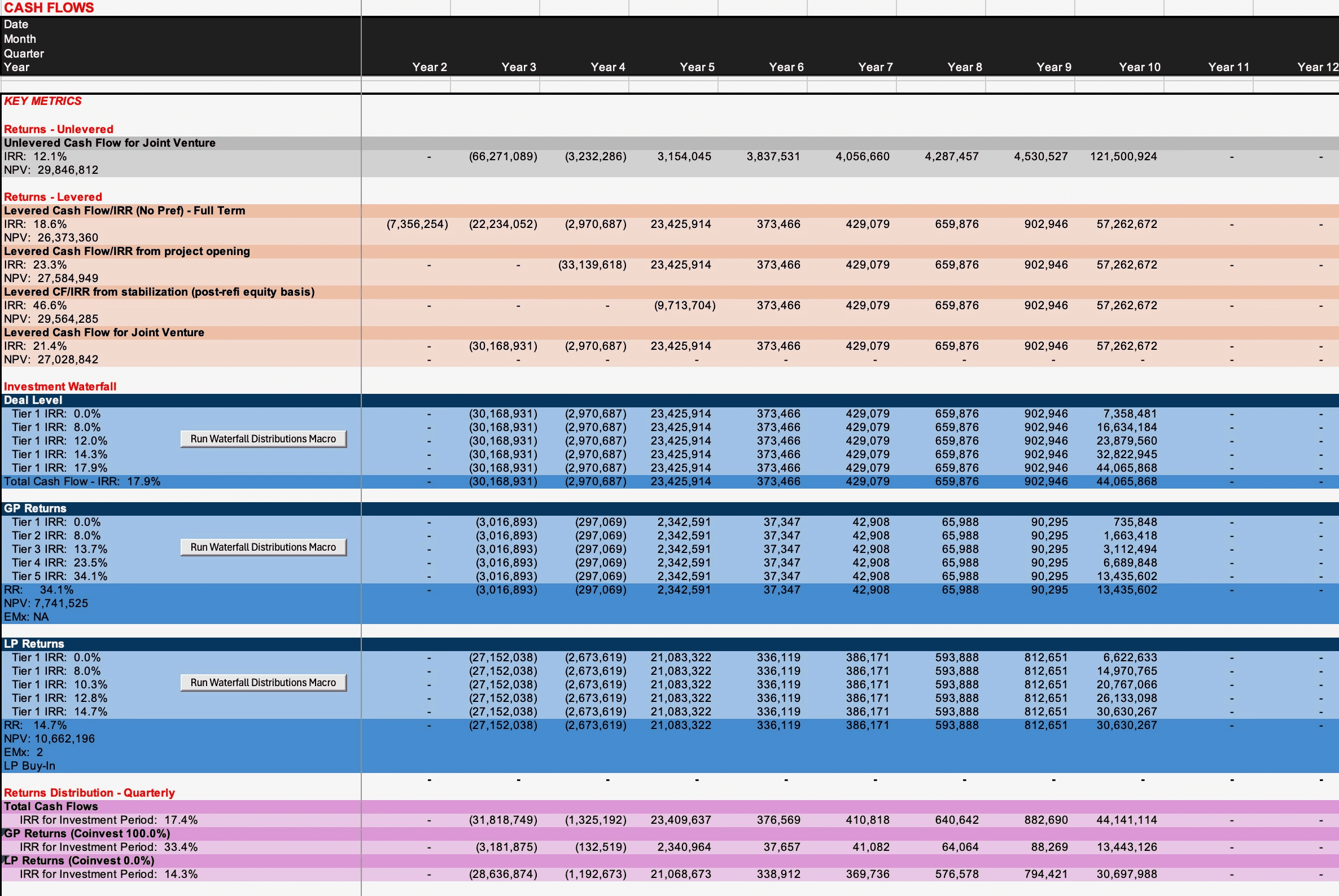
The Key Metrics section sits at the bottom of the cash flow tab, immediately above the capital and fee balance tracker, and reports returns across every meaningful entry point in the capital structure. Unlevered and levered IRR and NPV are calculated across multiple measurement periods — full term, from project opening, and from stabilization on a post-refi equity basis. This allows the GP to attribute their returns to specific phases of the deal lifecycle, while giving LPs the visibility to assess whether those returns are reasonable and non-extractive on JV entity terms — a distinction that matters when evaluating promote structures against the underlying deal performance.
The Investment Waterfall is measured from JV inception, the only period for which it is relevant. Because IRR-driven promote structures carry a level of computational complexity that formula-based approaches handle poorly, the waterfall is macro-driven — but the outcome is not a black box. Distributions for each tier of the promote are run directly within the cash flow, period by period, at the Deal, GP, and LP level. Each tier shows the cash flow series, the IRR at that threshold, and the final distribution balance, giving any reviewer a clear, visual record of how partner distributions accumulate and how returns are attributed at each stage of the waterfall.
The result is a structure that is both technically rigorous and immediately legible — intuitive enough to follow without explanation, and precise enough to validate that the model is working exactly as intended.
The Executive Summary Tab
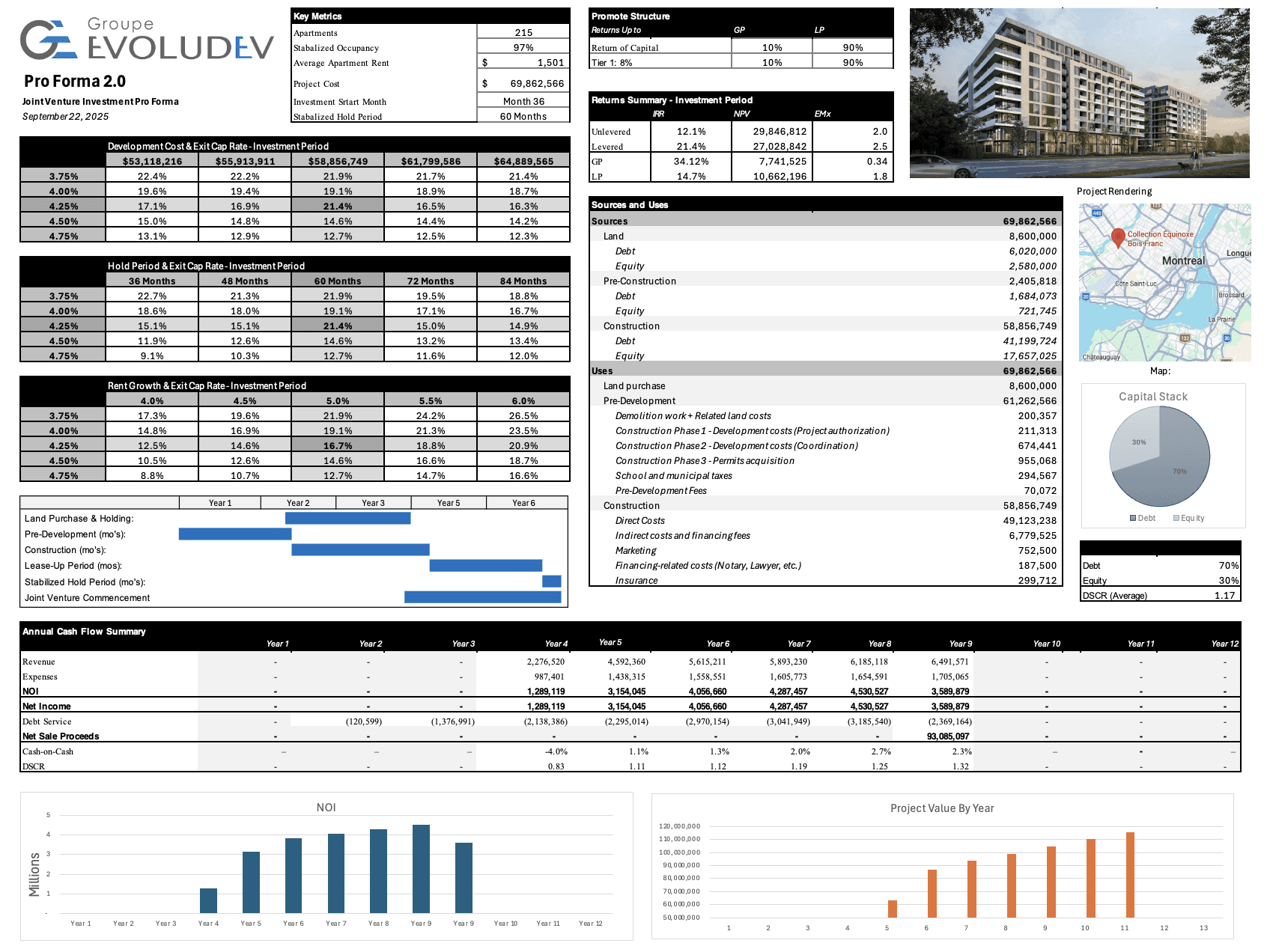
The executive summary is built for the decision-maker who needs the full picture without opening the model. Every metric a capital partner requires to evaluate the deal — returns at each level of the capital stack, cost and financing structure, promote terms, and operating performance — is presented on a single sheet, organized to support a conversation rather than require one.
Sensitivity tables across the three variables that drive institutional conviction — development cost, hold period, and rent growth — make it immediately clear how resilient the returns are and where the deal's real risk exposure sits. That context turns a returns summary into a defensible investment thesis.
The promote structure and partner-level returns sit side by side, so the alignment between GP and LP is visible without interpretation. Combined with a fully itemized Sources and Uses and a project timeline that grounds every assumption in a concrete schedule, the summary gives any capital partner — whether evaluating for the first time or preparing for an IC — exactly what they need to move forward with confidence.