Project Overview:
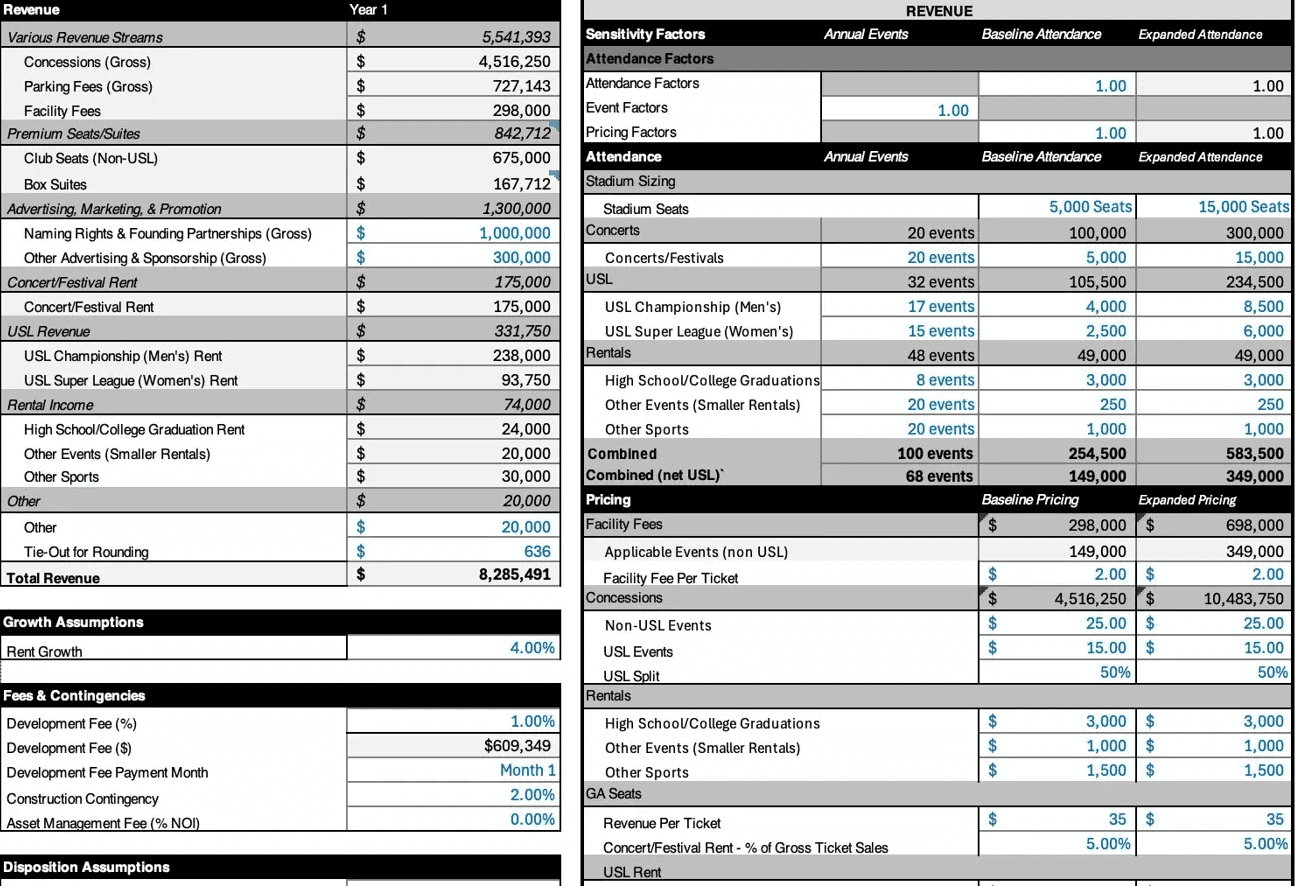
A real estate developer engaged InstitutionalModels™ to build the financial underwriting for a master-planned sports and entertainment district — a multi-asset, mixed-use development spanning residential, hospitality, a professional soccer venue, and for-sale horizontal residential.
The models were built to serve three audiences simultaneously: the city, to demonstrate feasibility and support a Tax Increment Financing (TIF) designation; lenders and investors, to obtain letters of intent; and the development team itself, to navigate a project where nearly every major assumption — capital stack, potential city grant, stadium sizing, phasing — was still in flux.
That last constraint shaped everything. The models needed to be fully adjustable as the project evolved, with scenario analysis built into every component and all assumptions transparent and easy to modify. At the same time, four distinct asset classes needed to follow a parallel structure — so that each model could stand alone for asset-level underwriting, roll up cleanly into district-wide returns, and be read by lenders and investors without any translation layer. Every dollar had to be tracked through the cash flow, auditable at every level, with no superfluous information and multiple validation layers throughout.
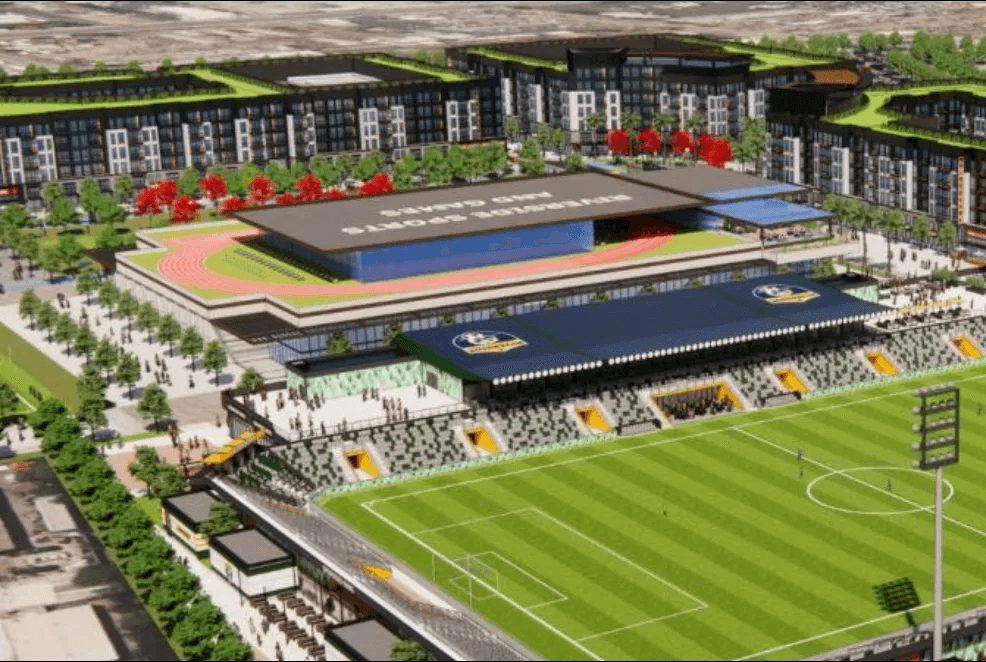
Four Asset Classes. Four Modeling Approaches.
Townhomes & Horizontal Development
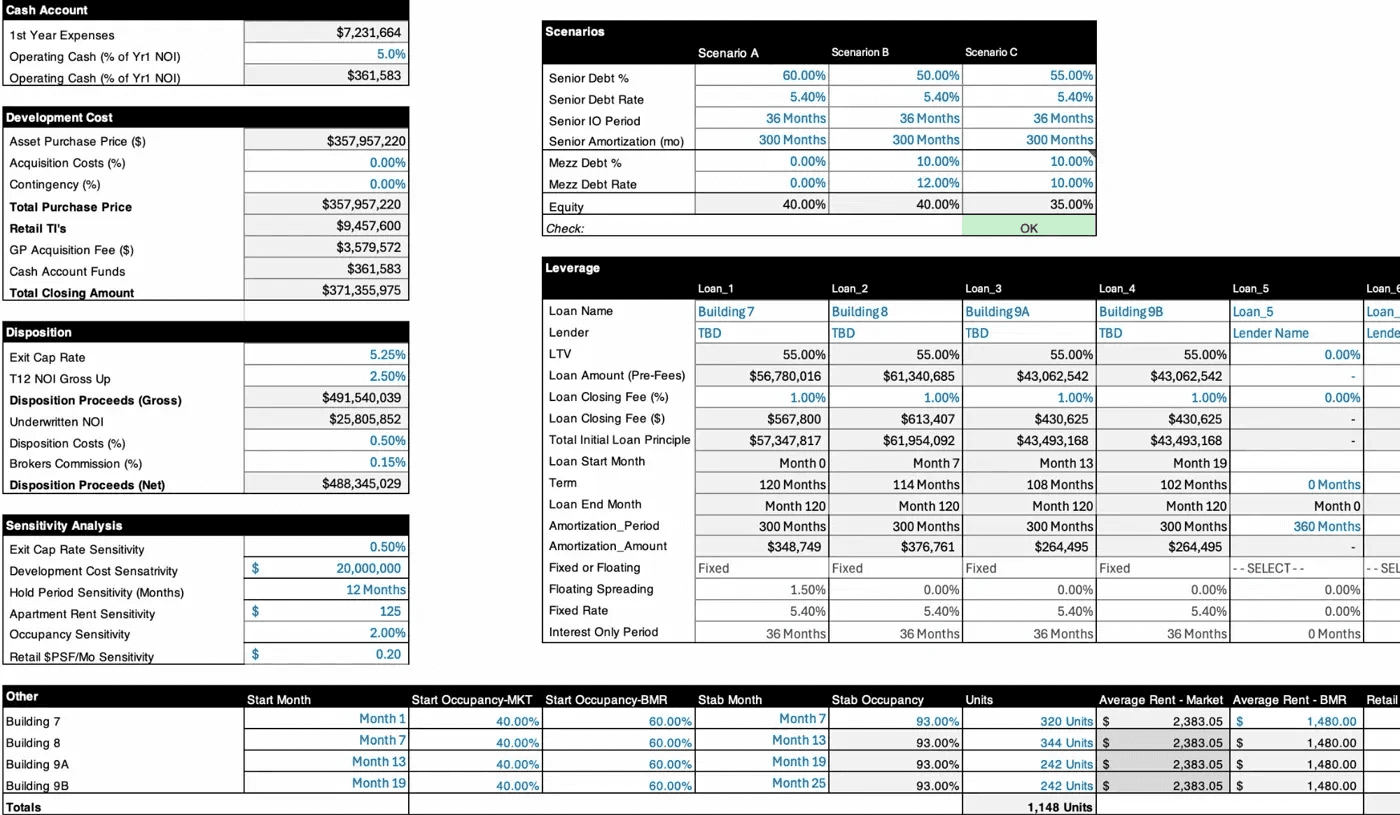
Model Features


Cash Flow Driver Rows and Audit Architecture
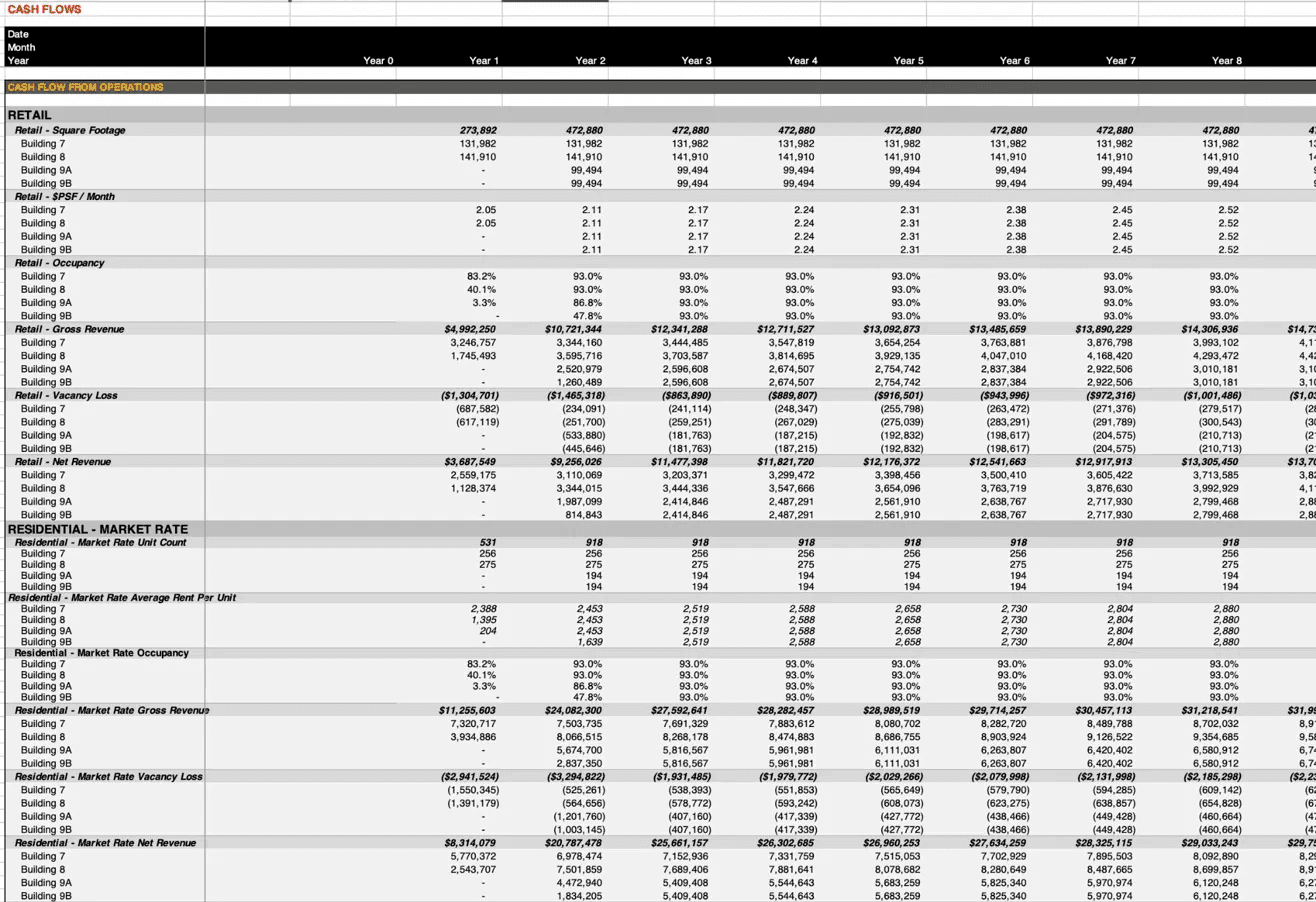
Between the dashboard inputs and the cash flow statement sits a layer of grey-formatted helper rows — driver cells that make explicit exactly what is powering each line of the model. Retail square footage by building, rent per square foot by phase, occupancy by phase: each is shown as a calculated intermediate before it flows into revenue.
This architecture serves two purposes. It makes the model fully auditable at the analyst level — any reviewer can trace a revenue figure directly to its input without reverse-engineering formulas. And it creates a natural documentation layer that makes the model usable by people who didn't build it, which matters in a city presentation context where multiple stakeholders need to interrogate the assumptions.

Formula-Driven Waterfall — No Macros
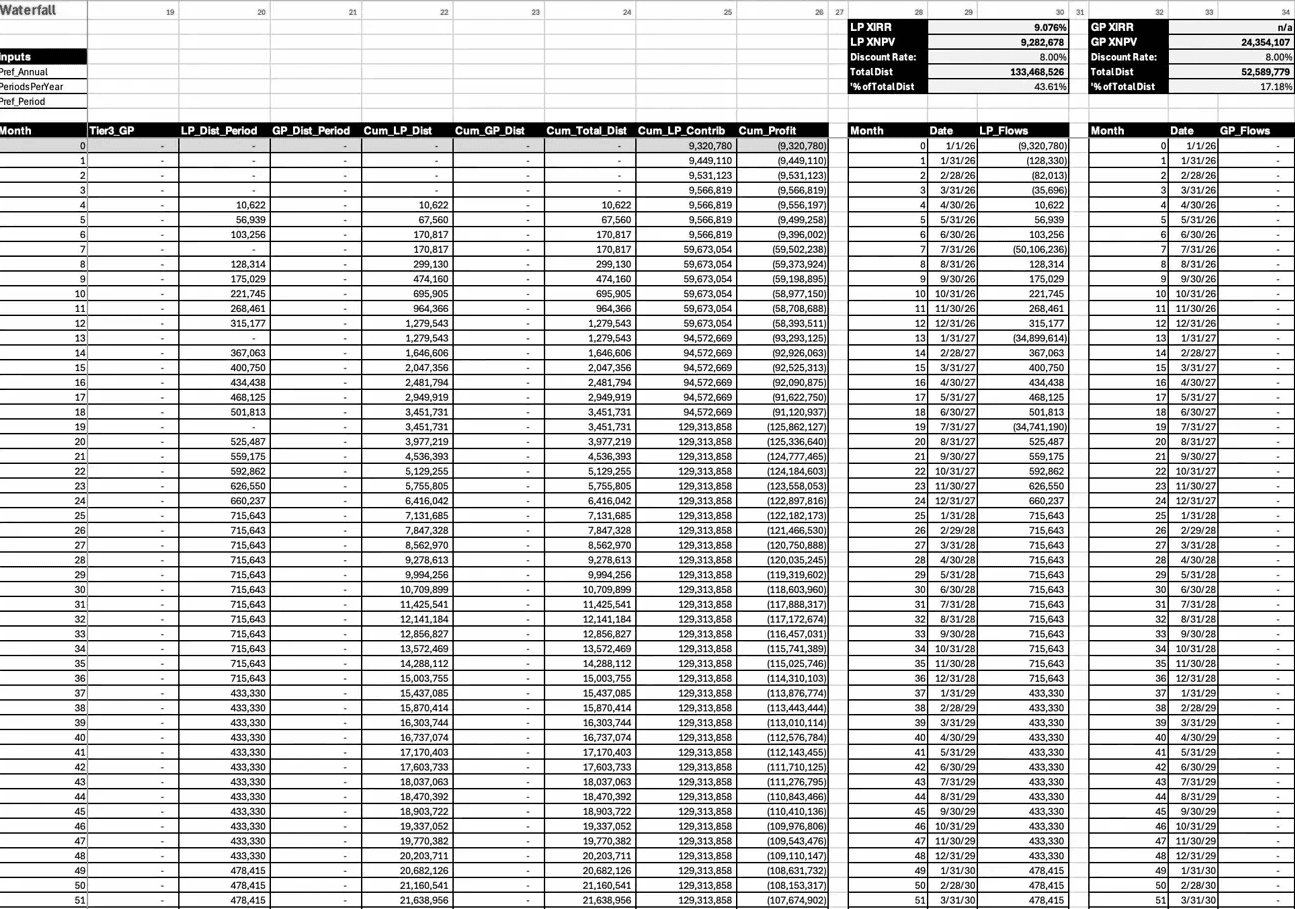
Each asset model contains a dedicated waterfall sheet running the full investment horizon at monthly granularity across 34 columns. The logic tracks return of capital, preferred return accrual, GP catch-up, and residual split — four tiers flowing entirely through formula, with no macros and no refresh step.
The practical effect is speed and fluency. Changing a rent assumption, a cap rate, or a hold period updates the LP XIRR, GP XIRR, XNPV, and cumulative distribution attribution for both parties instantaneously. A validation layer at the top of the sheet confirms that the waterfall reconciles to the underlying cash flows — so the model can be stress-tested rapidly without losing confidence in the output.

Individual Model Dashboards and Rollup
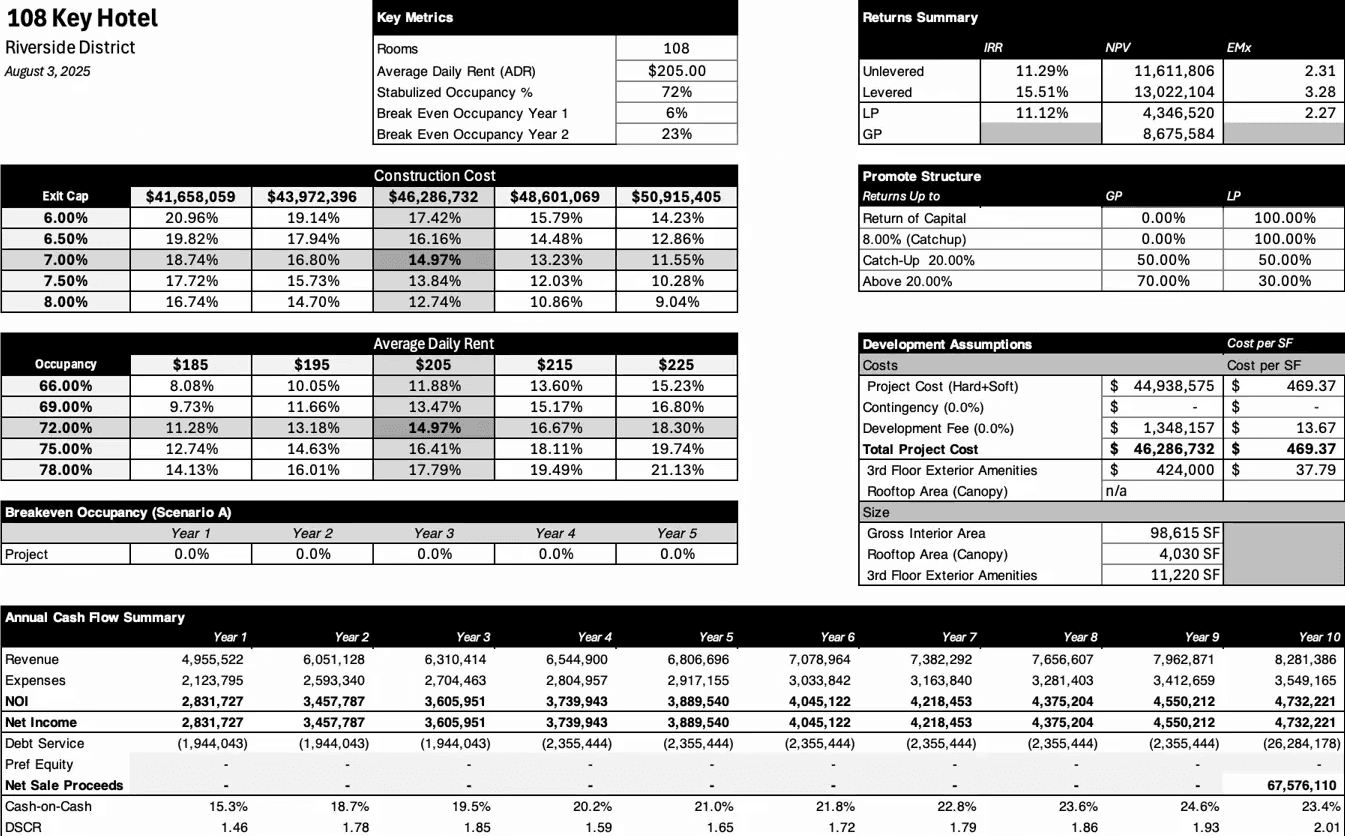
Each model in the suite has its own single-page dashboard presenting returns, sensitivity grids, promote structure, development assumptions, and annual cash flow summary in a format designed for executive review. Sensitivity tables are fully linked to base-case inputs — changing ADR, occupancy, or exit cap rate updates every grid simultaneously.
The hospitality dashboard illustrates the custom features built for each asset class: breakeven occupancy tracked annually, ADR sensitivity crossed against occupancy, construction cost sensitivity, and a promote structure summary — all on a single screen alongside the full annual cash flow summary. A rollup dashboard consolidates returns across all four assets for the city presentation.